
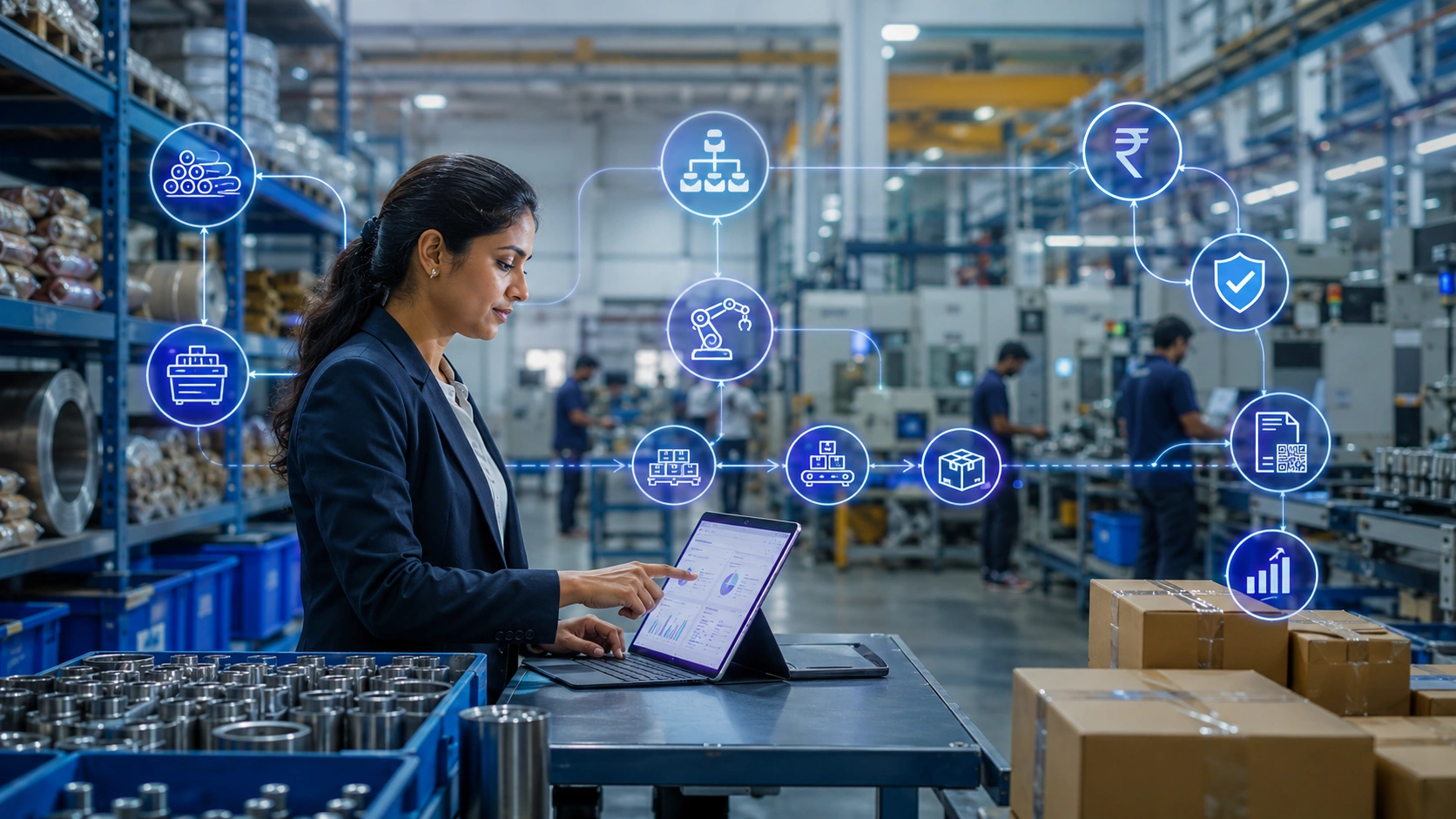
A garment unit in Tiruppur, a metal fabricator in Pune, a pharma packaging company in Hyderabad, a food processor in Coimbatore. Each is a different manufacturing operation with different raw materials, different production cycles, different GST rate structures, and different job-work arrangements. But all of them share the same fundamental finance problem: the production side of the business and the financial side do not talk to each other. Raw material consumption is tracked in one place, accounts are maintained in another, GST returns are filed through yet another. Every month, someone has to reconcile these three disconnected datasets and hope the numbers agree.
A manufacturing ERP software India platform is built to eliminate this disconnect. It connects production, including Bill of Materials, job-work orders, production costing, and inventory movements, to finance, GST compliance, and management reporting in a single platform. This guide explains what a manufacturing finance ERP actually does for an Indian MSME, which features genuinely matter versus which are marketing overhead, and how to evaluate platforms against the specific compliance requirements of the Indian manufacturing environment in 2026.
What Makes a Manufacturing Finance ERP Different from Standard Accounting Software
Standard accounting software handles the financial layer: invoices, ledgers, GST returns, and bank reconciliation. For a service business or a trading company, that is sufficient. For a manufacturer, it is not, because the financial picture of a manufacturing business is inseparable from what happens on the factory floor. A manufacturing ERP software India platform must connect both layers.
| Business Function | Standard Accounting Software | Manufacturing Finance ERP |
| Raw material tracking. | Purchase invoices recorded when received. No connection to what material was consumed in production. | Raw material receipts update inventory. Production orders consume materials automatically from stock based on BOM. Cost of materials consumed posts to WIP account without manual entry. |
| Production costing. | Not available. Cost of goods manufactured must be calculated manually from purchase records, labour sheets, and overhead allocations. | Actual production cost calculated automatically: raw material cost from BOM, labour from time tracking or standard rates, overhead per allocation method. Variance from standard cost flagged. |
| Work-in-progress (WIP). | No WIP tracking. Unfinished goods sit between raw material and finished goods with no system representation. | WIP account updated as production progresses through stages. Material issued, labour posted, and overhead absorbed at each stage. Closing WIP visible on balance sheet in real time. |
| Finished goods inventory. | Manual entry when production is complete. Prone to timing errors and quantity mismatches. | Finished goods inventory updated automatically when production order is closed. Quantity and cost both correct from the first entry. |
| Job-work compliance (ITC-04). | No native support. Challans generated manually. ITC-04 data compiled from spreadsheets at period-end. | Delivery challans for job-work dispatches generated from the system. Return tracking with deadline alerts. ITC-04 data auto-compiled from challan and receipt records. |
| GST on manufacturing transactions. | GST invoices for sales. No connection to production or job-work GST compliance. | B2B sales invoices with IRN generation. Job-work invoices with correct SAC 9988 rates. E-way bills for goods in transit. GSTR-2B reconciliation on both inward goods and job-work service invoices. |
| Management reporting. | P&L and balance sheet from accounting entries. No production metrics. | Cost per unit, production efficiency, material yield, and batch profitability alongside financial P&L, all from one data source. |
Source: NASSCOM reports ERP adoption among Indian MSMEs remains well below potential even as manufacturing grows under Make in India. Bizsol: Best Manufacturing ERP Software in India 2026.
The Seven Core Modules of a Manufacturing Finance ERP for Indian MSMEs
Not every platform that markets itself as manufacturing ERP software India covers all seven modules. Understanding what each module does, and whether it is native to the platform or requires a separate integration, is the most important evaluation step before committing to any system.
Module 1: Bill of Materials (BOM) Management
The BOM is the recipe for every product you manufacture: the exact raw materials, sub-assemblies, and quantities required to produce one unit of finished goods. In a manufacturing finance ERP, the BOM is the foundation for everything else. Production orders draw from it, raw material requirements are calculated from it, and production costs are valued using it.
- Multi-level BOM: a finished good contains sub-assemblies, each with its own BOM. The system must trace through all levels to calculate the total raw material requirement.
- BOM version control: when a product specification changes, the old BOM must be preserved for historical cost analysis while the new BOM takes effect from a defined date.
- Alternate materials: when a primary raw material is out of stock, the system must allow substitution with an alternate material tracked in the BOM.
- Cost rollup: the BOM-linked production cost should calculate automatically based on current raw material purchase prices, updating the standard cost when input prices change.
Module 2: Production Orders and Work Order Management
A production order is the instruction to the factory floor to manufacture a specific quantity of a product. The manufacturing ERP system converts a sales order or production plan into a work order, issues raw materials from inventory against the BOM, and tracks the production through each stage until finished goods are recorded.
- Work order creation from sales orders or production plan (MRP-driven).
- Material issue against production order: raw materials moved from raw material inventory to WIP automatically on work order release.
- Stage-wise production tracking: for multi-stage processes, each stage records completion, materials used, and time taken.
- Finished goods receipt: on production order closure, finished goods are added to inventory and the total production cost is calculated and posted to accounts.
Module 3: Inventory Management
For a manufacturer, inventory management software must handle three distinct inventory pools simultaneously: raw materials (inputs), work-in-progress (materials in production), and finished goods (ready for sale). Standard inventory tools typically manage only one. A manufacturing ERP connects all three and updates them automatically as production progresses.
- Real-time stock levels across all three inventory pools.
- Multi-location or multi-warehouse stock: raw materials at one site, production at another, finished goods at a warehouse or despatch area.
- Lot and batch tracking where required by the product type or regulatory requirement.
- Reorder point alerts and minimum stock level management for critical raw materials.
- Scrap and wastage recording: actual production rarely uses exactly the quantities specified in the BOM. The system must record yield and variance.
Module 4: Job-Work and Subcontracting Management
For MSME manufacturers who send materials to external vendors for processing, job-work tracking is a core compliance requirement under Section 143 of the CGST Act. The manufacturing ERP software India must handle this natively, not as a workaround using standard purchase or sales orders.
- Delivery challan generation with all Rule 55 CGST required fields for every job-work dispatch.
- Job-work dispatch register: every outward challan tracked with dispatch date, job worker GSTIN, goods description, quantity, and the 1-year return deadline.
- Return deadline alerts: automatic alerts before the 1-year limit on inputs and the 3-year limit on capital goods.
- Inward matching: goods received from job workers matched against original dispatch challans with quantity variance recording.
- ITC-04 data generation: outward dispatches, inward receipts, inter-job-worker transfers, and direct supplies compiled automatically for half-yearly (above Rs 5 crore AATO) or annual (Rs 5 crore and below) filing.
- Reverse charge on unregistered job worker invoices: processing charges from unregistered job workers captured for RCM reporting in GSTR-3B.
Module 5: GST Compliance Integration
Every transaction in a manufacturing business has a GST dimension. Raw material purchases carry input GST that feeds into ITC claims. Finished goods sales carry output GST. Job-work services received carry job-work GST at the applicable SAC 9988 rate. Goods in transit require e-way bills. A genuine manufacturing ERP software India connects all of these without requiring separate action for each one.
- GST-compliant billing with auto-calculation of CGST, SGST, IGST from HSN codes, updated for GST 2.0 rate changes from September 2025.
- Direct IRN generation for e-invoices: for businesses above Rs 5 crore AATO, IRN generated at the point of billing without portal login.
- E-way bill auto-generation from invoice or delivery challan data for qualifying consignments.
- GSTR-2B reconciliation automated: purchase invoices matched against GSTN supplier data. ITC mismatch flagged when ITC claimed exceeds GSTR-2B ITC by more than Rs 1 lakh or 20% of GSTR-2B ITC, whichever is lower (Rule 88D threshold).
- Job-work SAC 9988 invoice verification: job worker invoices validated against correct post-September 2025 rates (18% for engineering, 5% for textile, 12% for pharma).
Module 6: Production Costing and Financial Reporting
The financial layer of a manufacturing ERP must provide accurate cost of goods manufactured (COGM), cost of goods sold (COGS), and profitability by product or batch. These figures are not available from standard accounting software because they depend on production data that only flows from the manufacturing modules.
- Cost of goods manufactured: raw material cost plus direct labour plus manufacturing overhead, calculated per production order from actual inputs.
- Standard cost vs actual cost variance: where standard costs are set in the BOM, actual production costs are compared and variance reported.
- Batch profitability: revenue from the sale of a batch against the actual cost of production for that specific batch.
- Real-time P&L with COGM correctly reflected: calculated from production data, not estimated or entered manually.
- Balance sheet with WIP and finished goods at accurate cost: not at estimated values or the last physical count.
Module 7: Multi-User Cloud Access
Manufacturing operations involve multiple people who need simultaneous access to the same data: the factory floor supervisor checking raw material availability, the accounts team raising invoices, the business owner reviewing profitability, and the CA accessing GST returns. A manufacturing ERP must be cloud-native to support this.
- Role-based access: factory supervisor sees inventory and production, accounts sees billing and GST, CA sees financial reports and returns without production admin access.
- Mobile access: production supervisors and business owners need mobile access, not just desktop.
- Real-time data: the business owner checking stock levels or batch status sees current data, not the position as of the last nightly update.
What MSME Manufacturers in India Actually Need vs What Enterprise ERP Offers
The manufacturing ERP software India market includes platforms from enterprise systems designed for 500-person factories down to basic billing tools with a production module attached. Most Indian MSME manufacturers sit in a gap: they have outgrown basic accounting software, but enterprise ERP is architecturally too complex, too expensive to implement, and too slow to configure for their actual needs.
| ERP Type | What It Offers | Why It Does or Does Not Work for Indian MSME Manufacturers |
| Enterprise ERP (SAP, Microsoft Dynamics, Oracle). | Full manufacturing suite including MRP, shop floor control, quality management, advanced planning, HR, multi-currency, multi-entity. | Designed for 100-plus user factories with dedicated IT teams. Implementation takes 6 to 18 months and costs Rs 30 lakh to Rs 2 crore. Overkill for MSMEs below Rs 50 crore turnover. Indian GST compliance often requires additional customisation. |
| Open-source ERP (ERPNext, Odoo). | Full-featured manufacturing modules at zero licensing cost. BOM, work orders, MRP, subcontracting, and quality control natively included. | Requires technical implementation partner. Ongoing maintenance and update management needed. Good option for tech-forward MSMEs with budget for implementation (typically Rs 1.75 to 4 lakh). India GST depth varies: ERPNext has strong ITC-04 and e-invoice support; Odoo requires add-ons for Indian compliance. |
| MSME-focused cloud ERP with manufacturing (e.g. Elixir Books). | Manufacturing-specific modules (BOM, job-work, production costing) integrated with accounting, GST compliance, and e-invoicing in one cloud-native platform. Subscription pricing without implementation cost overhead. | Right fit for manufacturers with Rs 1 to 50 crore turnover. Indian compliance built in from day one. No dedicated IT team required. Faster to implement (2 to 4 weeks). Cost structure is subscription, not upfront licence. |
| Accounting software with manufacturing add-on (Tally plus manufacturing extension). | Core accounting with a manufacturing layer added through customisation or third-party module. | Fragile architecture. The manufacturing and accounting modules are often not truly integrated: data passes between them through exports or manual sync. GST compliance on job-work (ITC-04) typically requires manual work. Desktop-first architecture limits remote access. |
| Basic billing with inventory (Vyapar, simple cloud tools). | Invoice generation and stock management. Some support production orders at basic level. | Not suitable for manufacturers with more than 10 to 20 product variants, any job-work activity, or production costing requirements. GST compliance limited to basic invoicing. |
Source: For Indian MSME factories, the right ERP must combine purpose-built manufacturing modules with full GST e-invoicing and ITC-04 compliance at affordable subscription pricing. ERPDrive: Best ERP Software for MSME Manufacturers in India 2026.
Manufacturing ERP Evaluation Checklist for Indian MSME Manufacturers
Use this checklist when evaluating any manufacturing ERP software India platform. Request a live demo for each item marked mandatory. A vendor that cannot demonstrate any mandatory item in a working environment is showing you a roadmap, not a product.
| Feature | Priority | What to Verify in Demo |
| Multi-level BOM with cost rollup. | Mandatory. | Create a 3-level BOM. Change a raw material price. Verify the finished goods standard cost updates automatically. |
| Production order to finished goods workflow. | Mandatory. | Create a production order, issue materials against it, and close it. Verify finished goods stock increases and raw material stock decreases correctly. Verify WIP account moves. |
| Job-work challan generation (Rule 55 compliant). | Mandatory for job-work manufacturers. | Generate a delivery challan for job-work dispatch. Verify all 14 Rule 55 fields are present. Verify dispatch date is recorded. |
| Job-work return deadline tracking. | Mandatory for job-work manufacturers. | Ask to see the pending job-work return report. Verify the 1-year deadline is calculated from dispatch date, not order date. |
| ITC-04 data generation. | Mandatory for job-work manufacturers. | Ask to generate ITC-04 data for a period. Verify Tables 4 and 5 are populated from challan and receipt records automatically. |
| Direct IRP API for e-invoicing. | Mandatory for Rs 5 crore+ businesses. | Generate a test B2B invoice. Verify IRN is generated and QR code embedded without portal login. |
| GSTR-2B auto-reconciliation. | Mandatory. | Ask how GSTR-2B is pulled: via API (not manual download) and whether reconciliation is automated. |
| Inventory management across 3 pools (RM, WIP, FG). | Mandatory. | Check that separate stock ledgers exist for raw material, WIP, and finished goods. Verify each updates automatically from production transactions. |
| Production cost calculation (actual vs standard). | Strongly recommended. | Ask to see a production cost variance report for a completed production order. |
| E-way bill auto-generation from invoice. | Mandatory for goods manufacturers. | Create a qualifying invoice. Verify e-way bill is generated from the same data without separate entry. |
| Multi-location inventory. | Required for multi-site manufacturers. | Create stock at two locations. Transfer between them. Verify accounts reflect the movement correctly. |
| HSN code validation at invoice entry. | Mandatory. | Enter an invalid HSN code. Verify the system rejects it, not with a silent wrong-rate calculation. |
| CA access with controlled permissions. | Recommended. | Ask what role-based access is available. CA should see GST returns and financial reports without production module write access. |
| Data migration from Tally or existing system. | Important. | Ask about the migration process. What data can be imported? How long does it take for a typical manufacturer? |
| Mobile access for factory floor. | Recommended. | Open the platform on a mobile browser or app. Can a supervisor check stock or update a production order from the factory floor? |
GST Compliance Requirements Specific to Indian MSME Manufacturers in 2026
Manufacturing operations carry GST compliance obligations that go beyond what a service business or trader faces. A manufacturing ERP must handle all of these natively, not as workarounds using standard GST return templates.
1. E-Invoicing for Finished Goods Sales
Manufacturers above Rs 5 crore AATO must generate IRN for every B2B invoice. For businesses above Rs 10 crore AATO, the 30-day IRP upload deadline applies. Manufacturers with seasonal production peaks generating large invoice volumes in a short period are particularly exposed to the 30-day rule. A manufacturing ERP software that tracks upload status per invoice prevents batches from being missed.
2. E-Way Bills for Goods in Transit
Every shipment of finished goods exceeding Rs 50,000 in value (inter-state, or Rs 50,000 to Rs 1,00,000 intra-state depending on state) requires an e-way bill. Manufacturers dispatching multiple shipments per day need automatic e-way bill generation from invoice data. Manual portal generation per shipment is not operationally sustainable at scale.
3. ITC on Raw Material Purchases
Raw material purchases carry input GST that the manufacturer claims as ITC. Correct ITC claiming requires: the supplier’s invoice to appear in GSTR-2B (which means the supplier filed GSTR-1 on time), the HSN code on the purchase invoice to be correct, and the ITC claim to not exceed GSTR-2B available credit by more than Rs 1 lakh or 20% of GSTR-2B ITC, whichever is lower (the Rule 88D threshold). For a manufacturer with 100 to 400 purchase invoices per month across multiple raw material suppliers, automated GSTR-2B reconciliation is the only practical way to manage this correctly.
4. Reverse Charge on Purchases from Unregistered Vendors
Manufacturers often buy raw materials from small, unregistered suppliers, including farmers, artisans, and small processors. Where the supply falls under Reverse Charge Mechanism (RCM), the manufacturer must pay GST directly to the government on behalf of the supplier and report it in GSTR-3B. The manufacturing ERP must identify RCM transactions and auto-calculate the liability.
5. Job-Work Specific Compliance
If materials are sent for job work, the full compliance framework under Section 143 CGST Act applies: delivery challans, e-way bills for inter-state movement, 1-year return deadline tracking, ITC-04 half-yearly (above Rs 5 crore AATO) or annual (Rs 5 crore and below) filing, and RCM on unregistered job worker invoices. None of these are covered by standard accounting software.
6. Input Tax Credit on Capital Goods
When a manufacturer purchases capital goods (machinery, equipment), the ITC is available but must be tracked separately. Capital goods ITC cannot always be claimed in one period. The rules on ITC reversal for capital goods used for both taxable and exempt supplies require careful tracking over the useful life of the asset.
What MSME Manufacturers Gain When Finance and Production Connect
The case for a manufacturing ERP software India platform is not abstract. Here is what the connection between production and finance delivers in concrete operational terms for an MSME manufacturer.
| What You Currently Do Manually | What the ERP Does Instead | Benefit |
| Calculate how much raw material to order for next month’s production plan. | MRP calculates required quantities from the production plan, checks current stock, and generates purchase indents automatically. | Reduced raw material stockouts and overstocking. Purchasing cost typically 5 to 15% lower due to timely, quantity-optimised orders. |
| Record finished goods produced at end of shift (manual stock update). | Production order closure automatically updates finished goods inventory with correct quantity and cost. | Inventory accuracy improves from roughly 80 to 90% (manual) to near 100%. Overstocking, pilferage gaps, and customer shortfalls identified immediately. |
| Calculate production cost by batch (manual compilation from purchase invoices and labour sheets). | Actual cost per production order calculated automatically: materials from BOM issues, labour from time or standard rate, overhead per allocation. | Batch-level profitability visible in real time. Losing batches identified within the production period, not at year-end. |
| Manually compile job-work challan records for ITC-04 at period-end. | ITC-04 data auto-generated from challan and receipt records entered during the period. | ITC-04 filed in 30 minutes instead of 2 to 3 days. Missed deadlines and deemed supply risk eliminated. |
| Export data from accounting to separate GST tool for GSTR-2B reconciliation. | Purchase invoices in the system matched against GSTR-2B via API. Mismatch report generated in minutes. | Rs 72,000 to 1.44 lakh per year in CA reconciliation time saved. ITC claim accuracy improves to near 100%. |
| End-of-month stock take to reconcile physical inventory with books. | Inventory matches books continuously. Physical check confirms accuracy rather than discovering differences. | Physical stock count from 2 to 3 days quarterly to a 2-hour periodic audit verification. |
Elixir Books: Manufacturing Finance ERP Built for Indian MSME Manufacturers
Elixir Books is a manufacturing ERP software India platform designed for the specific operational and compliance requirements of Indian MSME manufacturers. It covers all seven core modules in a single cloud-native platform without the implementation overhead of enterprise ERP or the compliance gaps of adapted accounting software.
Here is how the platform covers each module described in this guide.
- BOM management: multi-level BOM with version control and automatic cost rollup from raw material purchase prices. Available as part of the manufacturing add-on module.
- Production orders: work order creation, material issue against BOM, stage-wise completion tracking, and finished goods receipt with automatic inventory and accounts update.
- Three-pool inventory: raw material, WIP, and finished goods tracked separately with real-time updates from every production transaction.
- Job-work management: Rule 55 compliant challan generation, dispatch register with 1-year return deadline tracking, inward receipt matching, and ITC-04 data generation from system records.
- GST e-invoicing with direct IRP API: IRN generated at point of billing, QR code embedded, e-way bill auto-generated from invoice data. Available as an add-on module.
- GSTR-2B reconciliation automated: purchase invoices matched against GSTN supplier data, mismatch report categorised by bucket, ITC eligible amount flows to GSTR-3B. Available as an add-on module.
- Production costing: actual cost per production order calculated from material issues, with variance from BOM standard cost.
- Real-time P&L with correct COGM: profitability by product, batch, or period from production data, not manual estimates.
- HSN code validation: codes validated against GSTN master at point of invoice entry, correct rates applied automatically.
- Multi-user cloud access: factory supervisor, accounts, business owner, and CA working simultaneously from any device.
For a full breakdown of platform features, see the Elixir Books features page. For pricing and available add-on modules, see the plans and pricing page.
Frequently Asked Questions
Q1. What Is a Manufacturing ERP and How Is It Different from Accounting Software?
A manufacturing ERP software India platform connects production operations, including Bill of Materials, work orders, raw material consumption, job-work management, and production costing, with the financial layer of accounting, GST compliance, and management reporting. Standard accounting software handles the financial layer but has no connection to what happens in the factory. The practical difference: in accounting software, the cost of goods manufactured is entered manually; in a manufacturing ERP, it is calculated automatically from production data. For MSME manufacturers with multiple product types, job-work vendors, or seasonal production cycles, the manual approach creates systematic errors that a manufacturing ERP eliminates structurally.
Q2. Does My MSME Really Need a Full ERP or Will Accounting Software Be Enough?
The threshold question is: does your business send materials for job-work processing, or manufacture goods from raw materials using a defined Bill of Materials? If yes to either, standard accounting software is not sufficient. The GST compliance obligation alone, including ITC-04 filing, delivery challan management, and job-work return deadline tracking, is not supported by standard accounting tools. If you also need production costing, inventory accuracy across raw material, WIP, and finished goods, and real-time profitability by product or batch, a manufacturing ERP is the correct choice. The entry-level cost of a cloud-native manufacturing ERP designed for Indian MSMEs is now comparable to good accounting software.
Q3. What Is a Bill of Materials and Why Does It Matter for GST Compliance?
A Bill of Materials (BOM) is the recipe for a manufactured product: the list of raw materials, sub-assemblies, and quantities required to produce one unit of the finished good. In a manufacturing ERP, the BOM drives production orders and raw material consumption. For GST compliance, the BOM matters because every raw material line item has its own HSN code and GST rate. When you claim ITC on raw material purchases, the ITC must be traceable to the production orders that consumed those materials. If the BOM is inaccurate, the ITC claim trail is unreliable, which creates exposure during GST audits or scrutiny of ITC usage. The manufacturing ERP connects BOM consumption to ITC tracking, making the paper trail complete.
Q4. How Does Manufacturing ERP Handle Job-Work GST Compliance?
Job-work compliance under Section 143 of the CGST Act requires: delivery challans for every goods dispatch, e-way bills for inter-state or above-threshold intra-state movements, tracking that materials return within 1 year (inputs) or 3 years (capital goods), half-yearly (above Rs 5 crore AATO) or annual (Rs 5 crore and below) ITC-04 filing, and Reverse Charge Mechanism on invoices from unregistered job workers. A genuine manufacturing ERP software India generates the delivery challans from the system, tracks the 1-year return deadline automatically with alerts, matches received goods against original challans, and compiles ITC-04 data from the records entered during the period. Without ERP support, each of these is a manual task that typically fails at some point during the year.
Q5. How Much Does Manufacturing ERP Software Cost for an Indian MSME?
Costs vary significantly by type. Enterprise platforms like SAP Business One cost Rs 3 to 8 lakh per year in licensing alone, plus implementation. Open-source platforms like ERPNext have zero licensing but require implementation of Rs 1.75 to 4 lakh and ongoing maintenance. Cloud-native MSME-focused manufacturing ERP software India platforms typically cost Rs 10,000 to 40,000 per year on subscription with no upfront implementation fee and go-live in 2 to 4 weeks. The correct comparison is not licensing cost but total cost of ownership over 3 years, including implementation, training, ongoing support, and the hidden cost of the manual workflows the ERP replaces, typically Rs 2 to 5 lakh per year in accountant time and compliance risk.
Q6. How Long Does It Take to Implement Manufacturing ERP Software for an Indian MSME?
Implementation time depends on the platform type and business complexity. Enterprise ERP implementations take 6 to 18 months. Open-source ERPNext implementations for MSME manufacturers typically take 8 to 12 weeks with a certified partner. Cloud-native MSME-focused manufacturing ERP platforms like Elixir Books typically go live in 2 to 4 weeks for most manufacturers. The critical steps are: master data setup (product catalogue, BOM, supplier and customer masters, opening stock and balances), GST API credentials configuration, user access setup, and a parallel run period to validate that production transactions flow correctly before cutting over fully. Manufacturers with complex multi-level BOM structures or large product catalogues should budget the upper end of these timelines.


Leave a Reply