
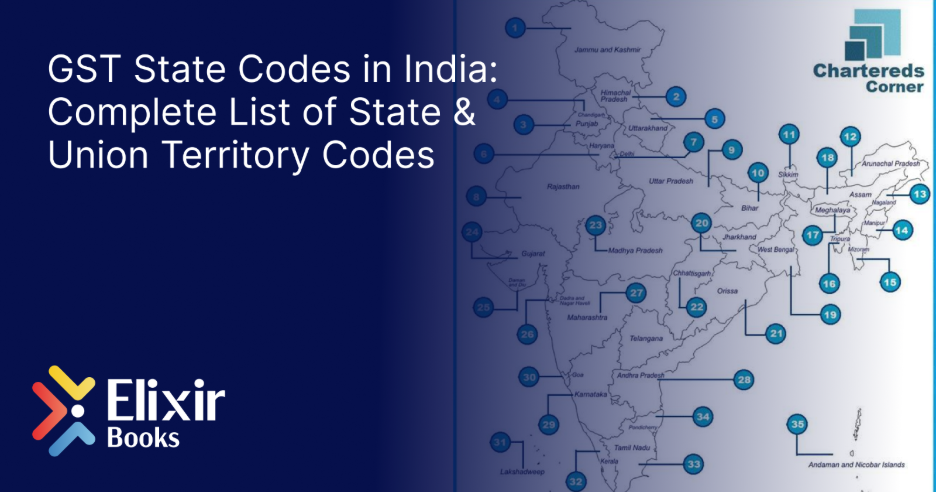
If you have ever looked at a GSTIN and wondered what the first two digits mean, the answer is simple: they identify the State or Union Territory associated with the GST registration.
Every State and Union Territory covered under the GST system has an assigned code. These codes are used across GST registrations, invoices, returns, e-invoices and other GST-related records.
For businesses, understanding GST State Codes is particularly important when maintaining customer information, preparing invoices and checking GSTIN details.
This guide explains what a GST State Code is, provides the complete GST State Code list, and explains how these codes are used in everyday GST accounting.
What is a GST State Code?
A GST State Code is a two-digit code used to identify a State or Union Territory under the Goods and Services Tax system.
It forms the first two digits of a GSTIN.
For example, consider this sample GSTIN:
33ABCDE1234F1Z5
Here:
33 = Tamil Nadu State Code
The remaining characters contain other information used to form the complete GSTIN.
So, simply by looking at the first two digits of a GSTIN, you can identify the State or Union Territory associated with that GST registration.
Complete GST State Code List in India
Here is the GST State Code list used for States and Union Territories:
| GST State Code | State / Union Territory |
|---|---|
| 01 | Jammu and Kashmir |
| 02 | Himachal Pradesh |
| 03 | Punjab |
| 04 | Chandigarh |
| 05 | Uttarakhand |
| 06 | Haryana |
| 07 | Delhi |
| 08 | Rajasthan |
| 09 | Uttar Pradesh |
| 10 | Bihar |
| 11 | Sikkim |
| 12 | Arunachal Pradesh |
| 13 | Nagaland |
| 14 | Manipur |
| 15 | Mizoram |
| 16 | Tripura |
| 17 | Meghalaya |
| 18 | Assam |
| 19 | West Bengal |
| 20 | Jharkhand |
| 21 | Odisha |
| 22 | Chhattisgarh |
| 23 | Madhya Pradesh |
| 24 | Gujarat |
| 26 | Dadra and Nagar Haveli and Daman and Diu |
| 27 | Maharashtra |
| 29 | Karnataka |
| 30 | Goa |
| 31 | Lakshadweep |
| 32 | Kerala |
| 33 | Tamil Nadu |
| 34 | Puducherry |
| 35 | Andaman and Nicobar Islands |
| 36 | Telangana |
| 37 | Andhra Pradesh |
| 38 | Ladakh |
| 97 | Other Territory |
You may notice that some numbers are missing from the sequence. State codes should therefore not be assumed based on numerical order. Businesses should always use the valid code prescribed in the GST system.
How to Find the State Code in a GSTIN
Finding the State Code in a GSTIN is easy.
Take this sample GSTIN:
29ABCDE1234F1Z5
Look at the first two digits:
29
From the GST State Code list, 29 represents Karnataka.
Similarly:
33ABCDE1234F1Z5
Here, 33 represents Tamil Nadu.
And:
27ABCDE1234F1Z5
Here, 27 represents Maharashtra.
This makes the first two digits a quick way to identify the State or Union Territory associated with a GST registration.
Why are GST State Codes Important?
GST is a destination-based tax system, and location plays an important role in determining how a transaction is treated.
State-related information can affect several areas of GST compliance, including:
- GST registration
- Customer and supplier GSTIN validation
- Tax invoices
- Place of supply
- E-invoicing
- E-way bills
- GST returns
- Interstate and intrastate transaction classification
Maintaining the correct State Code is therefore more than a data-entry requirement.
It forms part of maintaining accurate GST records.
GST State Code and Invoicing
When creating a GST invoice, businesses need accurate information about both the supplier and the recipient.
For registered customers, this usually includes:
- Customer name
- Billing address
- GSTIN
- State
- Place of supply
- Applicable tax details
The State Code contained in the customer’s GSTIN can help identify the State in which that GST registration is held.
This information can become particularly important when determining whether a supply is interstate or intrastate.
GST State Code and Place of Supply: Are They the Same?
Not necessarily.
This is an important distinction.
A GST State Code identifies the State or Union Territory associated with a GST registration.
Place of supply, on the other hand, is determined according to the applicable GST place-of-supply provisions for a particular transaction.
The two may be connected in many transactions, but businesses should not automatically assume that the State Code in a customer’s GSTIN is always the place of supply.
The correct place of supply should be determined based on the nature and circumstances of the transaction.
How State and Place of Supply Affect CGST, SGST and IGST
One reason State information is so important under GST is that the location of the supplier and place of supply help determine the type of GST applicable to a transaction.
Broadly:
Intrastate Supply
Where the location of the supplier and the place of supply are within the same State or applicable Union Territory, the transaction will generally attract:
CGST + SGST
or, where applicable:
CGST + UTGST
Interstate Supply
Where the location of the supplier and place of supply are in different States or Union Territories, the transaction will generally attract:
IGST
However, GST contains specific rules and exceptions for different types of transactions. Businesses should determine the correct tax treatment based on the applicable GST provisions rather than relying only on addresses or State Codes.
Example: Tamil Nadu Business Selling to a Karnataka Customer
Consider a business registered in Tamil Nadu.
Its GSTIN begins with:
33
Now suppose it sells goods to a GST-registered customer in Karnataka whose GSTIN begins with:
29
If the applicable place of supply is Karnataka, the transaction would generally be treated as an interstate supply and IGST would apply.
Now consider another applicable transaction where both the supplier location and place of supply are Tamil Nadu.
The transaction would generally be intrastate and CGST + SGST would apply.
This is why maintaining accurate customer State and place-of-supply information is important when creating GST invoices.
Why State Codes Matter in GSTR-1
State and place-of-supply information can also affect the outward supply information reported in GSTR-1.
Businesses need to ensure that invoices contain accurate GSTIN, transaction and place-of-supply information before preparing their GST returns.
An incorrect State or place of supply can potentially result in incorrect tax treatment or return information.
Before filing GSTR-1, businesses should therefore reconcile their sales records and review customer GST information.
GST State Codes and E-Invoicing
State Codes are also relevant when generating e-invoices.
E-invoice systems perform validations on invoice information, including State-related information.
If an invalid State Code is provided in applicable invoice fields, the invoice data can fail validation.
Businesses using accounting or billing software should therefore maintain accurate State information in customer, supplier, dispatch and shipping records.
GST State Codes and PIN Codes
Businesses should also ensure that the PIN code entered in an address corresponds correctly with the applicable State.
E-invoice systems can perform validations between State Codes and PIN codes.
For example, entering a Tamil Nadu State Code while providing a PIN code belonging to another State can potentially cause validation problems.
This is another reason customer and supplier master data should be reviewed carefully.
Common Mistakes Businesses Make with GST State Codes
1. Selecting the Wrong State
A customer may have branches in multiple States.
Businesses should use the information relating to the relevant GST registration and transaction rather than simply selecting the customer’s head-office State.
2. Entering the GSTIN Incorrectly
A typing error in the first two digits can result in a GSTIN that does not correspond with the intended State.
Always verify GSTIN details before saving a customer record.
3. Assuming GST State Code and Place of Supply are Always the Same
They are not necessarily the same.
Place of supply must be determined according to the applicable GST rules for the transaction.
4. Using Incorrect State and PIN Code Combinations
The State and PIN code entered in customer, supplier or shipping information should correspond correctly.
5. Using Outdated State Information
India’s State and Union Territory structure has changed over time.
For example, Ladakh has State Code 38, while Dadra and Nagar Haveli and Daman and Diu are represented together under Code 26.
Businesses should therefore rely on the current GST master information rather than old State Code lists saved in spreadsheets or other records.
Why Accurate Customer Master Data Matters
Many GST errors begin with incorrect master data.
If a customer’s GSTIN, State, address or place-of-supply information is incorrect at the time an invoice is created, that error can flow into subsequent accounting and GST records.
Businesses should therefore maintain accurate customer information from the beginning.
Important customer details can include:
- Legal or business name
- Billing address
- Shipping address
- GSTIN
- State
- PIN code
- Place of supply, where applicable
Keeping these records organised reduces repetitive data entry and can make GST reconciliation easier.
Manage GST-Ready Business Records with Elixir Books
Accurate GST compliance starts with accurate accounting data.
Elixir Books helps businesses maintain accounting, invoicing, customer information, GST-related records and inventory in one connected system.
Keeping customer GSTINs, invoices and transaction information organised can help reduce manual work and make your records easier to review when preparing GST returns.
Instead of correcting basic customer information at the end of every filing period, businesses can maintain cleaner records from the moment a transaction is created.
Accounting. GST. Inventory. All connected with Elixir Books.
Frequently Asked Questions About GST State Codes
1. What is a GST State Code?
A GST State Code is a two-digit code used to identify a State or Union Territory within the GST system.
2. Where can I find the State Code in a GSTIN?
The first two digits of a GSTIN represent the State Code associated with that GST registration.
3. Is the GST State Code the same as the Place of Supply?
Not always. The State Code identifies the State or Union Territory associated with a GST registration, while the place of supply is determined according to applicable GST rules for the transaction.
4. Why is the State Code important on a GST invoice?
Correct State and place-of-supply information helps businesses determine and report the appropriate GST treatment, including whether CGST and SGST/UTGST or IGST may apply.
5. What happens if I enter the wrong State Code?
Incorrect State information can result in validation errors, incorrect invoice information or GST reporting issues. Businesses should verify the GSTIN, State, PIN code and applicable place of supply before completing a transaction.
Final Thoughts
GST State Codes may look like a small part of a GSTIN, but they play an important role in GST registration, invoicing and compliance.
The first two digits of a GSTIN help identify the State or Union Territory associated with the registration, while accurate State and place-of-supply information helps businesses apply and report GST correctly.
Instead of checking State Codes manually every time an invoice is created, businesses should maintain accurate customer and supplier information within their accounting system.
With organised records and connected accounting, GST compliance becomes easier to manage.




Leave a Reply